Advanced Teleop Package Frontend
The core tutorial used Radar first because it can run as a deployment without installing an application-specific browser frontend. Teleop is the next layer. It shows how a managed package can carry its own frontend and command its application subsystem instance through the runtime-managed proxy.
Neither browser surface is a native Librux subsystem. Both stay outside the
native runtime boundary and connect through librux-control.
world viewer -> /api/v1/ws/events      -> observe app events
world viewer -> simulator API   -> read/reset tutorial world state
teleop UI    -> package proxy   -> command app.cleaner.teleop
Native Event, Control, Procedure, and Operation traffic stays inside the Librux host. Browser UIs only see host-control and managed package frontend facades.
1. Open The World Viewer
The cleaner arena is a static world viewer under tutorials/frontend.
The important files are these.
| File | Role |
|---|---|
index.html |
page layout and canvas |
styles.css |
arena styling |
app.js |
app-event WebSocket client and canvas drawing |
run_sim_world.py serves this directory with Python's static HTTP server. It
does not start robot subsystems.
2. Read The World Viewer Facade Client
Open the browser code.
nano tutorials/frontend/app.js
Near the top of the file, the frontend defines the app event topic.
const APP_TOPIC = 'robot_cleaner/app/status';
It opens two WebSockets.
/api/v1/ws/events
/api/v1/ws/control
/api/v1/ws/events receives application status. /api/v1/ws/control is still available for
host-control automation, but the normal world viewer does not use it for teleop
commands. World state, reset, and trash spawn use the provided simulator HTTP
API; those are not robot gateway endpoints.
3. Prepare The Platform For Teleop
Stop the radar deployment if it is still running.
librux deploy down tutorials/deployments/radar.deployment.yaml
Start the reusable platform without an application.
librux deploy up tutorials/deployments/stages/robot.deployment.yaml
Open this URL.
http://127.0.0.1:8091/
The page starts simulator polling immediately and attempts to attach to the
runtime event stream automatically. Before a runtime connection is available,
the browser remains useful as a simulator view. It shows world online when
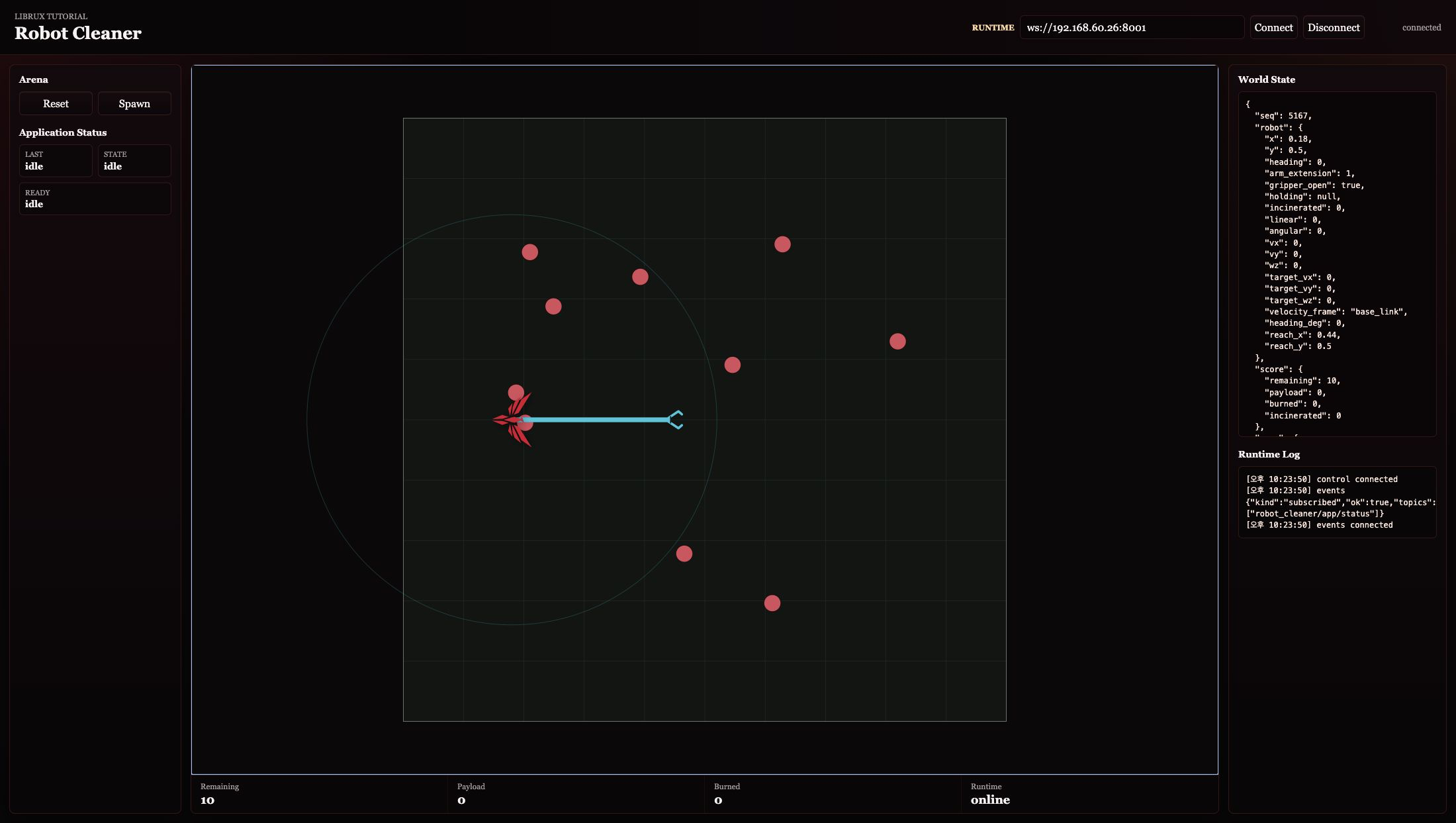
the simulator API is reachable and upgrades to runtime online when the
runtime event facade is reachable.
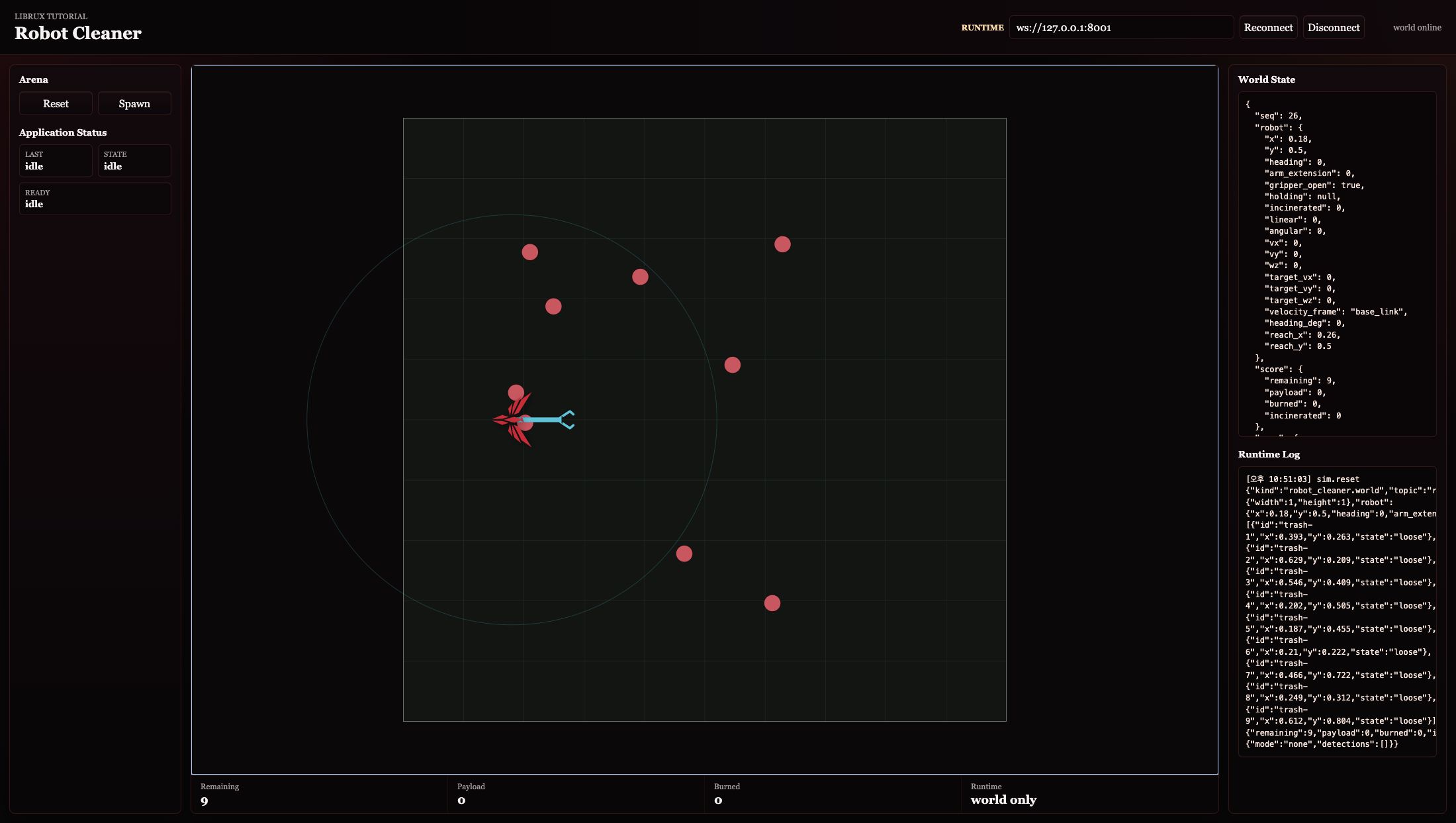
After the automatic runtime connection is online, the world viewer also shows application status events. At this point, no teleop app is running yet, so the status may remain idle.
4. Install And Launch Teleop
Teleoperation uses an installed managed package instance as the command target, and the controls are packaged with the teleop application subsystem.
If the teleop package is not installed yet, build an archive and install it from the Web Console Packages page.
librux package build tutorials/subsystems/app.cleaner.teleop \
  --out /tmp/librux-teleop-app \
  --force
tar -czf /tmp/librux-teleop-app.tgz -C /tmp/librux-teleop-app .
Then go to Runtime, choose Launch package instance, select
tutorial.robot_cleaner.teleop, and launch it with this instance id.
app.cleaner.teleop
Open the package frontend from Runtime, or use the instance URL.
http://127.0.0.1:8001/api/v1/packages/tutorial.robot_cleaner.teleop/ui/?instance=app.cleaner.teleop&context=/api/v1/packages/tutorial.robot_cleaner.teleop/instances/app.cleaner.teleop/context
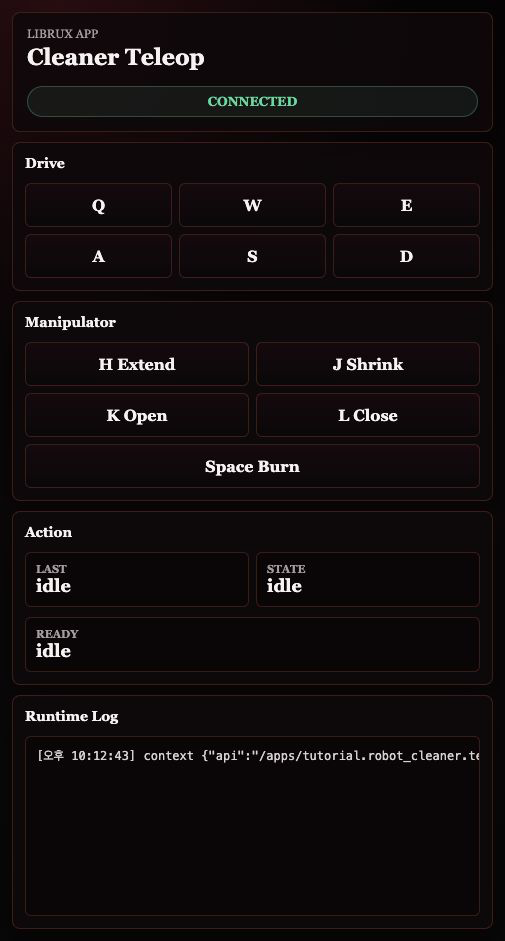
The teleop frontend is the operator control surface. It can be placed beside the world viewer and shrinks to a narrow browser column for split-screen testing.
5. Command Through The App Proxy
When the operator presses a button or key, the package frontend calls the managed same-origin package proxy. The proxy forwards the request to the app's brokered loopback frontend API. For teleop, the app then calls bound robot capabilities.
teleop package frontend
  -> /api/v1/packages/tutorial.robot_cleaner.teleop/instances/app.cleaner.teleop/api/command
  -> app.cleaner.teleop
  -> compound.cleaner
  -> component.mobile / component.manipulation / component.gripper
  -> gateway.device_gateway
This keeps the browser from bypassing the application policy.
Movement keys in the teleop package frontend are hold-to-drive. The browser keeps
refreshing a short-lived velocity command while the key or button is held, and
sends stop when it is released. Movement is robot-relative. After rotating the
robot, W drives forward in the direction the robot is facing.
| Key | Action |
|---|---|
W or Up |
drive forward in the robot body frame |
S or Down |
drive backward in the robot body frame |
A or Left |
strafe left in the robot body frame |
D or Right |
strafe right in the robot body frame |
Q |
rotate counter-clockwise |
E |
rotate clockwise |
H |
extend the manipulator |
J |
shrink the manipulator |
K |
open the gripper |
L |
close the gripper |
| Space | burn trash stored in the robot body |
Manual collection is intentionally step-by-step.
- Open the gripper with
K. - Extend the manipulator with
Htoward a piece of trash. - Close the gripper with
L. - Shrink the manipulator with
Jto bring the trash into the robot body. - Press Space to burn the stored payload.
If the gripper is closed while extending, the arm pushes loose trash away. If the gripper is open while extending, the trash is not pushed; closing the gripper near the arm tip grabs it. If you shrink without a closed gripper hold, the trash stays in the arena. If you do not burn stored trash, it remains as payload on the robot and can accumulate.
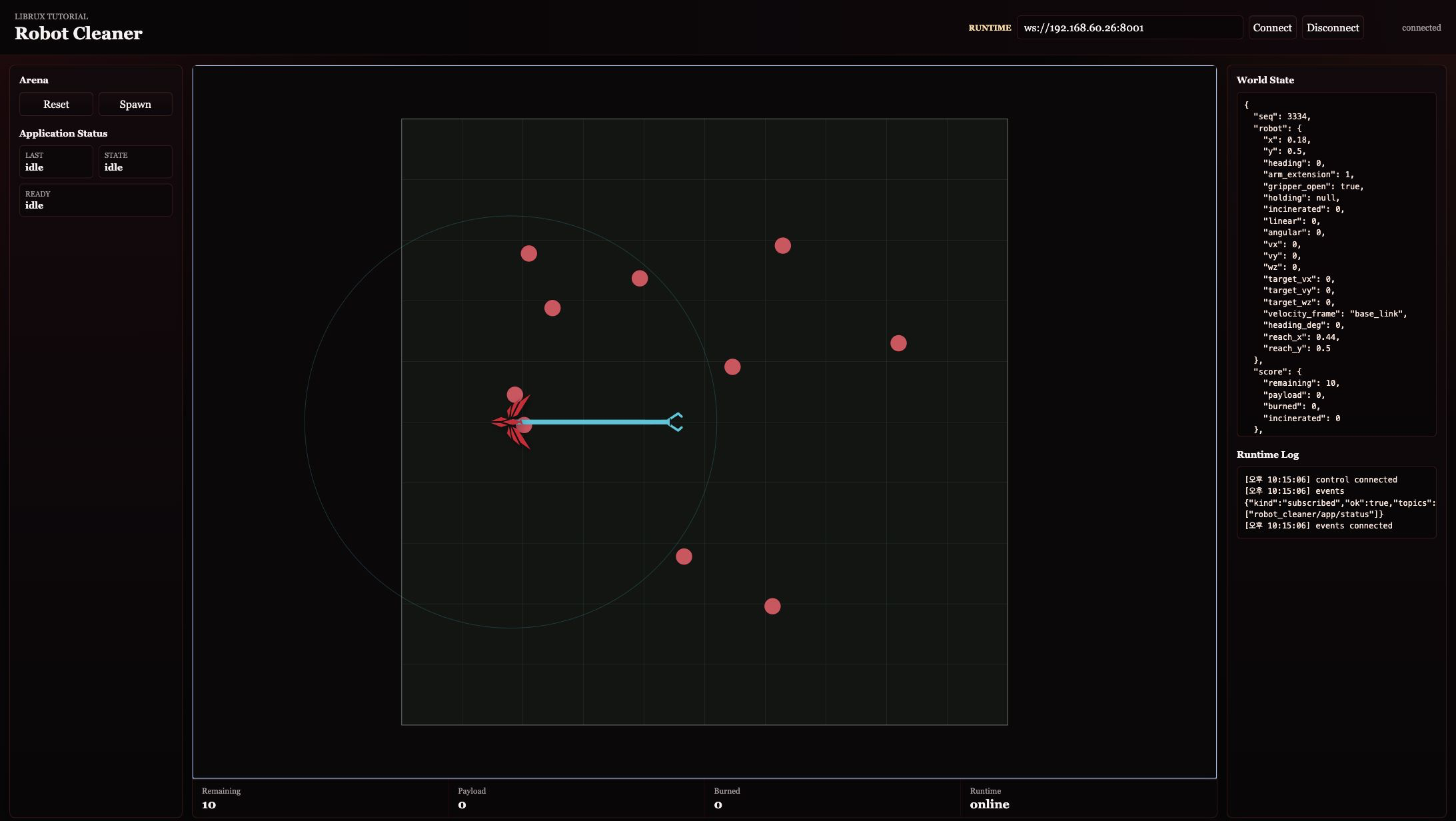
The teleop package frontend shows the latest command result. Payload in the world
viewer bottom status strip is the number of trash items currently stored in the
robot body and not yet burned.
6. Browser Defaults For Remote Runs
The frontend defaults to the page host for both runtime connections.
- WebSocket control backend -
ws://<page-host>:8001 - simulator API -
http://<page-host>:8092
On a local install, open.
http://127.0.0.1:8091/
For a remote runtime host, bind the tutorial world to all interfaces.
python3 tutorials/run_sim_world.py --host 0.0.0.0
Then start the platform deployment on that host.
librux deploy up tutorials/deployments/stages/robot.deployment.yaml
Then open this URL.
http://<runtime-host>:8091/
Reload the world viewer after starting the platform and teleop package instance.
Use Reconnect only after restarting librux-control or changing the
host/port path. The world viewer does not start or switch applications. Use the
teleop package frontend only when the teleop package instance is running. Explicit
ws, sim, and connect query parameters are intended for automated checks or
unusual proxy layouts, not the normal tutorial path.
Cleaner Robot Browser Graph
The world viewer is a visualization surface. The teleop package frontend is an operator surface, but it still does not bypass the application subsystem.
Continue to Advanced Resource Policy.